This is me playing Chapter 2 of SRW Z3.2. Enjoy!

Hello! My name is Christian Buffum-Robbins and this is my blog. I'll be doing game reviews, mecha anime reviews, and spewing liberal agenda. Hope you enjoy yourselves!
Showing posts with label Mechanime. Show all posts
Showing posts with label Mechanime. Show all posts
Thursday, February 11, 2016
Press Start vs Mecahnime: Super Robot Wars Z3.2 Playthrough (part 3)
This is me playing Chapter 2 of SRW Z3.2. Enjoy!

Saturday, January 30, 2016
Press Start vs Mechanime: Super Robot Wars Z3.2 Playthrough (part 2)
Tuesday, January 26, 2016
Press Start vs Mechanime: Super Robot Wars Z3.2 Playthrough (part 1)
This Christmas I finally got my hands on Super Robot Wars Z3.2, and since I haven't done anything mecha related for a while, I'd thought it would be cool if I shared my playthrough with you guys. I plan to post a video at least once a week.
This first video is the two prologue chapters, which is primarily to introduce the player to the game's mechanics. It really shows off what some of your units can do in terms of battle.
I apologize for the terrible editing. This is my first major experience with video editing. Hopefully it's not too big a distraction.
Enjoy!
Monday, September 21, 2015
Mechanime: Brave Express Might Gaine
 |
| As a wise man once said: "I like trains." |
Number of Episodes: 47
Average Episode Length: 21 minutes
Subgenres: Shounen
Dub?: No
I would like to thank the Planetary Defense Subtitling Group for subbing Might Gaine. I couldn’t have done this review without their sub.
Usually I choose what I review at random. However, I chose to to watch Might Gaine out of curiousity, thanks to how much I like J-Decker, and partially thanks to the show’s gimmick of trains. Unfortunately, the best thing Might Gaine did for me is further my appreciation for J-Decker. As per usual, this is a review of the first 13 episodes, but unlike Eureka Seven or J-Decker, there won’t be a follow-up with this.
Opening
Note: I could not find a good MP3 of the opening. Might Gaine's OP should be on YouTube. Check it out if you're curious enough.
Given that the Brave series has 8 openings to its name, it would make sense that some openings are better than others. Might Gaine’s opening, called “Arashi no Hero (meaning Hero of Storms),” sadly, is one of the lesser ones. The song is perhaps the cheesiest, most 90s-ist thing I’ve ever heard, but instead of being a glorious guilty pleasure, it just ends up being average. It didn't impress me, but at the same time, I didn’t find it to be offensively bad. In terms of opening themes for the Brave series, this is probably right in the middle.
Story
 |
| Nouville Tokyo is the setting of the anime. |
Might Gaine takes place in the near future, fifty years after the disappearance of oil. Society has since been able to rebuild itself since then thanks to advancements in electrical energy and robotics. Still the world is a very dangerous place, with criminals and evil masterminds having access to dangerous new technologies. Luckily for the citizens of Nouville Tokyo, a new hero has appeared on the scene. His name is Maito Senpuuji, a teenage boy who has recently acquired his late father’s company. Together with robots equipped with sentient AI, he vows to rid his home of Nouville Tokyo of all crime.
I will say that the story of Might Gaine has an interesting setup. But despite how interesting the concept of a world without oil is, the story of Might Gaine seems to use it solely to explain why the robots are trains, as electric trains are the only viable mode of public transport left. The story also has a big problem with tone; it repeatedly hints at how dangerous the world has become since oil’s disappearance, yet the actual tone of the show is very lighthearted and silly. The story as a whole feels very generic, as most episodes boil down to a criminal starting trouble, and Maito and his robots show up to save the day. The story has potential, but sadly it never gets past the standard shounen plot.
Characters
 |
| The main villains of the series. From left to right: Shogun Mifune, Don Hoikowloh, Joe Rival, Catherine, and Wolfgang. |
Sit down, I have quite a bit to say about the characters. Let’s start as we usually do; an objective look at both the heroic and villainous sides. Our heroes include Maito, the main protagonist of the story, Izumi, the main secretary of the Senpuuji Corporation, Aoki, Maito’s butler and resident Alfred stand-in, Hamada, Maito’s best friend and head engineer, and Sally, Maito’s love interest. On the villainous side, we have Wolfgang, a mad scientist obsessed with the creating “the world’s strongest machine,” Hoikowloh, a Chinese mob boss who sells his robots to the highest bidder, Shogun Mifune, a terrorist who wishes to destroy technology, Catherine, a world class jewel thief, and Joe Rival, a former fighter pilot who only wishes to find and defeat the perfect opponent.
 |
| Maito and the three main robots. From left to right: Guard Diver, Might Gaine, and Tribomber. |
On the robot side, we have Gaine, Maito’s partner that helps form the titular robot of the series. Supporting him are the Bombers, a group of three robots that have both a vehicle form and a animal form. They are Lio Bomber, Bird Bomber, and Dino Bomber. The other support team are the Divers, a group of robots built for rescue purposes; the group includes Fire Diver (a fire engine), Police Diver (a police chaser), Jet Diver (a fighter jet), and Drill Diver (a drill tank). The Bombers can combine to form the powerful Tribomber, and the Divers can unite to form Guard Diver.
Before I get started on judging the cast, I want to point out that this show has a character named Joe Rival. That’s not a nickname, that’s his actual name. That is so dumb it wraps around and becomes awesome.
After the solid cast of J-Decker, this cast came as an unpleasant surprise. The biggest offender is Maito, who is a blatant Marty Stu (a implausible perfect character who is beloved by everyone). He’s rich, good looking, athletic, and no one calls him out on shirking his responsibilities as a company president. And it’s not like his allies are any better; all of them are derivative, forgettable, and bland. The villains fair slightly better, as they have gimmicks to compensate for their one-note personalities. I appreciated how they stuck to five big bad guys as opposed to creating a new villain every week. The villains aren’t actually strong though; they’re only interesting in comparison to the lackluster cast of heroes.
 |
| This line contains the whole personality of Gaine. I'm serious. |
What they did with the robots, however, is just downright sad. Unlike J-Decker, were each robot had a defined personality, strengths, and weaknesses, the robots in Might Gaine are all practically interchangeable. Gaine has barely a personality to speak of, and each support team has only one trait to share between them. They are boring as all hell, which is a huge disappointment. The robots are central part of any robot show, and when you can get invested or even get interested in any of the robots, they show fails. The entire cast of Might Gaine may be a pack of forgettable cutouts, but for the robots to have so little personality made an otherwise dull cast into a poor cast.
Writing
 |
| This is an actual line. And it's played completely straight. I know this is a kid's show, but come on... |
The writing in this show is just as bad as the cast. The dialogue is derivative and flat, and the humor is even more so. The characterization is terrible all across the board, with boring characters and even more boring robots. This is a huge shame, as good writing is one of the things that could have saved this show. Instead, we get paint-by-numbers cast members, predictable plots, a half baked world, and robots just as deep as the toys they were meant to sell.
Animation
 |
| Gaine's transformation sequence. |
There are some good things about Might Gaine. Perhaps the best thing about this show is the animation. The animation is smooth and there are few hiccups. It’s more low budget than J-Decker, as it has some much more noticeable shortcuts, feels and looks less polished overall, and it’s much more willing to recycle its animation. For instance, all the gattai sequences are recycled, which is fine, given how well animated they are. However, Might Gaine’s gattai sequence is more than a minute long, and for all of the first 13 episodes, it insisted on playing out in its entirety. Also, Might Gaine uses the same finisher in every fight, meaning another minute of beautiful but nevertheless recycle animation. This show isn’t as bad as Golion when it comes to recycling it's animation, but it's still annoying that nearly a tenth of every episode is stock footage.
Mecha and Fight Scenes
 |
| Might Gain's finisher involves a vertical cut that splits the enemy in two. It's always the best part of an episode. |
Despite being bland, the robots of Might Gaine are well designed. Like in J-Decker, the base robots are the right mixture of simplicity and detail; not terribly complex, but having enough visual appeal to avoid being boring to look at. The combined robots look really good too, but are more complex and cooler looking than J-Decker’s giant robots. It also helps that this show really goes above and beyond with the whole train concept. The main robot can transform into a train, and can combine with a bigger train to make the titular giant robot. A team of three triple changers, all of which have trains as their vehicle forms, can take the form of a larger train by default. A team of four robots can meld together to form their own giant train. That’s a lot of trains.
 |
| Tribomber engaging in a fierce slideshow battle with the Robot of the Week. |
But like J-Decker, the fight scenes in Might Gaine range from “nothing special” to “uneventful and boring.” The fights often don’t have a lot going on, and often devolve into a slideshow rather than an animated fight. In most fights, you’ll be lucky to see any remotely interesting before Might Gaine’s finisher, and while the finisher itself is awesome, it gets old after the third time you see it. Honestly, I would have forgiven this anime for most of its shortcomings if it had good fights. New Getter Robo is a case of that. But the lame fight scenes turned out just to be another problem on Might Gaine’s long list of flaws.
Conclusion
Might Gaine has a lot of potential to make a great anime, but it squanders a lot of it. While it does have good animation and cool looking robots, it's largely a derivative, paint-by-numbers mecha show that does little to differentiate itself from its peers. Unlike J-Decker, this does feel like a 21 minute weekly toy commercial. I can’t recommend this unless you’re dying to see all the Brave shows; otherwise, don’t even bother with this one.
5.5/10 - Mediocre
Friday, August 21, 2015
Mechanime: Psalms of Planets Eureka Seven
 |
| This anime has robots, hoverboards, and robots on hoverboards! |
Number of Episodes: 51
Average Episode Length: 22 minutes
Subgenres: Adventure, Romance
Dub?: Yes
In Mechanime related news, I’ve stopped watching Gundam Wing. It got to the point where the story, no matter how good, couldn’t save the experience. I consider it a good show, but I know believe it’s very hit or miss, and for me, it got to the point where it started missing more than hitting. However, since then, I’ve finally gotten around to watching Eureka Seven, which I don’t think I’ll be dropping anytime soon. Keep in mind that this is more a review of the first season rather than the whole show.
Opening
The OP of Eureka Seven, called “Days,” is pretty different from most openings I’ve heard. It’s a pretty groovy piece of music, and it gives me this carefree feeling whenever I listen to it. It gives you that sense that everything will work out while at the same time being fun to listen to. It’s one of the best I’ve listened too, not only because it's a good song, but also because it differentiates itself from your average opening.
Story
 |
| It's pronounced "ur-ekk-ah," by the way. |
Eureka Seven takes place in the distant future. Mankind has learned to harness the power of transparence light particles (or “trapars”), which are given off by a mysterious lifeform called scub corals. Renton Thurston, a teenage boy growing up in a backwater town, desperately wants to escape his boring life. An opportunity literally falls from the sky in the form of Eureka, a mysterious girl, and her mech, the Nirvash typeZero. He is invited to join the Gekkostate, an outlaw militia group led by Holland Novak. As Renton spends more time with Eureka and the members of the Gekkostate, he learns not only more about the real life of the outlaw group, but also more about the world.
 |
| Despite the relatively light tone of the first season, it has its darker moments. |
There’s a lot more to a story than the basic plot, as Eureka Seven demonstrates beautifully. One of the major pillars of storytelling is world building, something that this show does really well. Information is given to the audience at a rate that isn’t too slow (which would bore the audience) or fast (which would feel like an infodump). The world is interesting, and I kept watching to so I could learn more about it. The actual story feels more like a coming of age adventure which slowly unfurls into something much more interesting. The world, at least in the first season, is more interesting that the actual plot, but I will say that as more information becomes known, the plot grows more interesting.
Characters
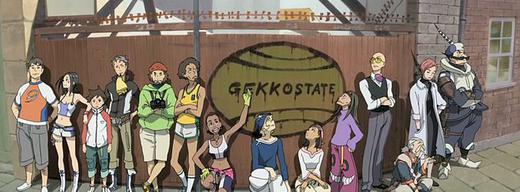 |
| The crew of the Gekkostate. From left to right: Hap, Talho, Renton, Holland, Stoner, Matthieu, Hilda, Moondoggie, Gidget, Woz, Jobs, Gonzy, Mischa, Ken-gou. Whew. Image source: Wikipedia |
Eureka Seven has a pretty big cast. Aside from Renton, Eureka, and Holland, there’s the many members of the Gekkostate. We have pilots Matthieu and Hilda, who operate the Terminus 606 and Terminus 808 respectively, Talho, the captain of the Gekko (the Gekkostate’s flagship), and Hap, the Gekko’s second in command. On the villainous side, we have Dewey, a commander in the United Federation Forces and Holland’s brother, Anemone, a psychotic counterpart to Eureka, and Dominic, an intelligence officer. There are more characters, but most aren’t terribly important to the overall plot (at least not yet).
 |
| The main character is sadly the weak link here. |
Eureka Seven has a great cast. Most characters are likeable and entertaining. Even the more annoying ones are tolerable. Most left me wanting to know more about their lives and personalities, especially the villains. However, the cast has one major deadweight, and sadly, it’s the main character. I find Renton to be very annoying, being a deadly combination of being whiny, oblivious to reality, and a little self absorbed. It also doesn’t help that he has the worst voice on the entire show. If Renton was a secondary member of the Gekko, then I could let it slide, but since he’s the main character, he gets a lot a screen time, which makes it far worse than it has to be. Save for Renton, the rest of the cast is great, especially Eureka, Holland, and the big villains.
Writing
There’s more to writing than dialogue; there’s also world building and how you handle exposition. One of the reasons the world building is so great in Eureka Seven is that the writing delivers the information at a pace that keeps the audience interested while still focusing on the main adventure. The dialogue itself is good too, being able to capture the personalities of each of the characters and is able to fit the tone of each scene. Eureka Seven is well written, especially when it comes to world building.
Animation
 |
| Eureka is on the left . The amazing landscape is in the back. |
The animation of this show is freaking fantastic. The whole show feels very fluid and it rarely recycles its animation. It feels more like a long running OVA rather than a made for TV animated show. The scenes that best show off the animation are the sequences were the Gekkostate’s mecha have to maneuver to avoid enemy fire. It really shows how fast and fluid the animation can be without cutting corners. It also helps how colorful and complex the animation can be sometimes. This is probably the best animated anime I’ve said that didn’t include CGI.
Mecha and Fight Scenes
 |
| The Nirvash typeZero, the main mech of Eureka Seven. |
The mecha in Eureka Seven are known as Light Finding Operations, or LFOs. They have two forms: a vehicle form that looks like a tank-sports car hybrid, and a humanoid robot that can fly by riding the currents produced by trapars with a board. All the mecha in this show are great. They look detailed and interesting, and each look gives off a certain personality vibe. Even the grunt mecha used by the military look really cool. The mecha in Eureka Seven are really unique and well designed, and it’s a treat to see them in action.
 |
| The grunt mechs of Eureka Seven. |
The draw of the show is not within the fight scenes. The fights in this show are few and far between, and they are usually short, with the grunt mecha blown away with a single attack. However, I don’t find this to be disappointing, since the main draws are the stories and characters. It also works because the heroes aren’t invincible. Unlike Gundam Wing, were the protagonist were practically invincible, the heroes in Eureka Seven do feel in danger enough to feel like they can be killed. It’s a welcome change, in my opinion.
Sub or Dub?
This is the first show I can actually recommend the english dub. Each voice actor does a good (and sometimes even great) job with the character given to them. It’s a good dub, and in my opinion, a good dub is almost always better than a good sub.
Conclusion
Eureka Seven has several great things going for it. It has a great world, a good story, some great characters, and awesome mecha. It has some really good animation, and some sequences look outstanding. Really the only problem I have with the show is Renton, and I’m hoping character development will save the day in the future. Other than that, I highly recommend this series.
8/10 - Great
Thursday, August 13, 2015
Mechanime vs Sentai Time! Top Ten Super Sentai Mecha Themes
Ever since Battle Fever J (or even Gorangers, one could argue), the multicolored heroes of the Super Sentai franchise have used mecha as a key part of their arsenal. These mecha are usually the ultimate weapon of the sentai, and almost always finish off the monster of the week. Each mech has its own theme, and usually they are tons of fun to listen to. Today, I’m counting down my top ten favorite themes. There’s only one rule: only one theme per show. Let’s get going.
10. Hot! Hot! GaoMuscle
Sentai: Hyakujuu Sentai Gaoranger
Vocalist: Yukio Yamagata
Note: I couldn't find a good mp3 of this song. The song is on YouTube, so you can listen to it there.
Note: I couldn't find a good mp3 of this song. The song is on YouTube, so you can listen to it there.
I like it when a theme does something different and still ends up being enjoyable. GaoMuscle’s theme is very different from your average mecha theme. It has some odd instrumentals with an off-kilter melody, and the song is much better for it. Its weirdness is its greatest asset, especially with all the grunting in the background. This theme stands out in a great way, and it’s very fun to listen to. That said, it’s at the bottom for not quite reaching the same level of “fun to listen to” as the other choices. Still, this is a very fun song, and it deserves a spot on this list.
9. Engine Gattai! Engine-Oh G6
Sentai: Engine Sentai Go-Onger
Vocalist: MoJo (Ichiro Tomita)
Credit is due where credit is due; I may dislike Go-Onger as a show, but its mecha themes are all great. Choosing just one for the list was tough, but in the end I went with the one that pumped me up the most. This song does a great job of building up to the chorus, and boy, what a chorus. It also helps that this song has the legendary MoJo singing, and he does a great job with every lyric. The instrumentals are also great, and the brass complements the vocals greatly. This is a flashy and dramatic song, and it’s the greatest song Go-Onger has to offer.
8. Ginga no Ouja Gingaioh
Sentai: Seijuu Sentai Gingaman
Vocalist: Miyauchi Takayuki
A lot of the earlier themes didn’t really stand out to me. This one, however, manage to capture the dramatic spirit of many of the earlier mech themes while still being able to stand above the rest. With great use of brass and strings, it captures a feeling of drama, tension, and power. The vocals have the same effect; with the chorus and main singer, it magnifies the power of the song. The combination of great instrumentals and vocals made this theme this theme fantastic, while the other earlier themes were just “good” or “great.”
7. Samurai Gattai! ShinkenOh
Sentai: Samurai Sentai Shinkenger
Vocalist: Akira Kushida
You want drama? This theme will give you plenty of that. This theme has very pumping instrumentals from the guitar and drums that help keep up the theme’s energy throughout the song, and the dashes of more traditional instruments are great. And may I just say that the bridge is probably one of the best in any song ever? Seriously, the power that one section of the song has is just incredible. This song demands your attention in the best of ways, and is well at home in my favorite Super Sentai show.
6. Makka na Toukon! Red Puncher
Sentai: Chouriki Sentai Ohranger
Vocalist: Hironobu Kageyama
Hironobu Kageyama is my second favorite Japanese vocalist (if you’re wondering who’s my favorite, just keep reading), and this song is a good reason why. This song has the perfect mix of 90s cheese and killer brass, managing to be stupid, awesome, and stupidly awesome all at the same time. It’s incredibly fun to listen to, and Kageyama absolutely sells this. This song really gets you ready for any crap an evil intergalactic empire has to throw at you.
5. KYORYUZIN
Sentai: Zyuden Sentai Kyoryuger
Vocalist: NoB (Nobuo Yamada)
Now we’re talking! This song is just so fun to listen to, with its near perfect mix of wicked guitar and showy brass. It’s a fairly simple song with a hypnotically awesome melody, and the chorus is worthy enough to be played at sporting events. This theme just oozes with awesome, and is just as addicting as all of Kyoryuger’s other songs. I may be a bit biased, seeing that I love Kyoryuger, but I think this theme deserves a spot on this list.
4. Zettai Shouri da! VRV
Sentai: Gekisou Sentai Carranger
Vocalist: Norio Sakai
It’s a bit ironic that Carranger, a parodic season of Super Sentai, has one of the best mech themes out there. Nevertheless, this a very feel good song, with enough drama and power to make it something truly amazing. The verses sound stereotypically heroic, but they’re still very enjoyable. The greatest part of this song is when the chorus kicks in, with a very hopeful sounding instrumental and sweeping vocals. It truly is a musical treat, even it is a bit silly.
3. Make Legend! Magiranger!
Sentai: Mahou Sentai Magiranger
Vocalist: Ichiro Mizuki (Toshio Hayakawa)
Ichiro Mizuki is easily my favorite Japanese vocalist, and this song is a perfect example why. This song carries itself with a great grand spirit, with absolutely amazing instrumentals that just nail the heroic spirit of Super Sentai. Mizuki’s vocals top it all off, with powerful and sweeping vocals that complete this song. I may be cheating with this entry, as this is both the theme for the Magiranger’s super form and MagiLegend, but there was no way I wasn’t going to exclude such a perfect song for this list.
2. Li-Oh! Kenzan! Champion!
Sentai: Tokumei Sentai Go-Busters
Vocalist: Ichiro Mizuki (Toshio Hayakawa)
This song is the absolute king of being channeling the old school spirit without completely sucking. Like previous entries, it has a killer combination of both brass and strings, and with the addition of a saxophone, we have a nearly perfect example of old school style tokusatsu songs. Just like the last entry, Mizuki’s vocals make the song, complementing the amazing instrumentals to make something magnificent. It misses out on being number one by just and inch, but it remains one of the greatest pieces of Super Sentai music ever.
This song has all of what makes the previous songs great. It has great instrumentals, with a absolutely heavenly mix of guitar and orchestral music. It fits the heroism and drama of Super Sentai to a T. The vocalist pushes the song from being “good” to being “fantastic.” It’s bridge and chorus are incredible. There’s virtually nothing wrong with this song, and everything it does is golden. This is easily the best mech theme in all of Super Sentai.
1. ToQ Sou Shingeki
Sentai: Ressha Sentai ToQger
Vocalist: Yukio Yamagata
This song has all of what makes the previous songs great. It has great instrumentals, with a absolutely heavenly mix of guitar and orchestral music. It fits the heroism and drama of Super Sentai to a T. The vocalist pushes the song from being “good” to being “fantastic.” It’s bridge and chorus are incredible. There’s virtually nothing wrong with this song, and everything it does is golden. This is easily the best mech theme in all of Super Sentai.
Saturday, July 4, 2015
Mechanime: Final thoughts on Nobunaga the Fool (light spoilers)
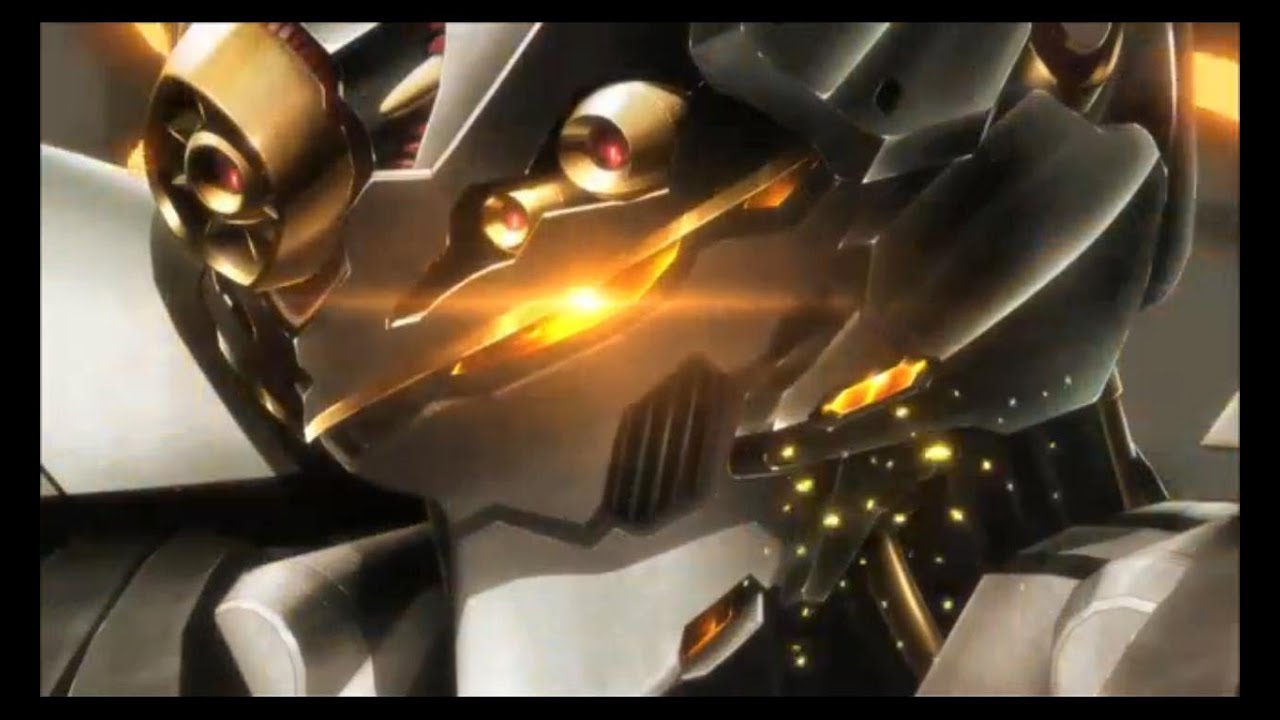 |
| I still believe that this anime must be seen. |
So I finally got around to finishing Nobunaga the Fool, and I have to say, the last few episodes of the anime really impressed me.
Watching this anime in chunks has allowed me to better appreciate the shifts in tone the story goes through. While never terribly lighthearted, the series does start out much lighter than when it ends. The last few episodes in particular got really dark really fast. This usually happened when I watched the last episodes:
Me: Well at least things can’t get any worse.
Show: (goes even further south)
Me: Well crap…
This isn’t a bad things though. Nobunaga the Fool handles its tone very well. Things gradually descend into chaos (except for the last episodes, were things go south at supersonic speeds), and nothing feels like it’s totally out of left field. The tone always feels appropriate, which is one of the greatest parts of Nobunaga the Fool, and part of the reason I like it so much.
The last few episodes also highlighted the main theme of the anime: a clash of ideals and ideologies. Is it worth living a life without death, even if that means a lack of passion or motivation? Is free will worth the suffering that comes with it? While I previously commented on how one-sided the whole East vs West thing is (the Westerners are clearly the bad guys, I have to give them credit for trying, and for the most part succeeding at, to present to different views on life and suffering.
In the end, Nobunaga the Fool remains my favorite mecha anime thus far, and I found its conclusion very satisfying.
 |
| This frees up space for Eureka Seven. To the skies! |
Wednesday, June 17, 2015
Mechanime: Brave Police J Decker
 |
| HOLD UP! |
Original Run: 1994-1995
Number of Episodes: 48
Average Episode Length: 21 minutes
Subgenres: Shounen
Dub?: No
Welcome back to Mechanime! Today we’ll be looking at an entry in the influential Brave series, J-Decker. Before we get to the review, I feel like I should address the history of the Brave series, as it’s important to understand the series as a whole.
A Brief History Lesson
 |
| The main Braves throughout history. J Decker is the fifth one. |
The Brave series owes a lot to the Transformers franchise, and not only because they share a similar concept (robots that can take the form of vehicles fighting evil). Takara, the company that had the rights to the Transformers in Japan, had departed from Generation 1 in 1989. When the series began declining in popularity (resulting in the cancellation of the Transformers: Zone OVA series), Takara struck a deal with Sunrise, the studio behind the wildly popular Gundam series to create a new franchise alongside a new set of toys.
The Brave series is very similar to Transformers with one major exception: the draw was that the robots could combine. Usually, the main robot could combine with a large vehicle (usually a carrier of sorts) to form a more powerful robot. There were also usually two support teams of multiple robots that could also combine. Takara often reused assets such as toy molds leftover from their Transformers days when making toys, as well when designing their robots.
The first entry in the Brave series, Exkaiser, was far more popular than either Takara or Sunrise anticipated. Japanese audiences clamored for more, leading to 7 more entries in the Brave series, as well as a general revival of interest in the super robot genre. Even Transformers have references to the Brave series. Hope all of this helps in understanding the series when you think, “are you sure this isn’t Transformers?”.
Opening
All of the Brave animes have great openings, and J-Decker is no exception. The opening song, titled Heart to Heart, is a song filled to the brim with 90s cheese, and that’s exactly what makes it great. Not only is it overly dramatic, but it has this snack food like quality that makes it so you can’t stop listening to it. Heart to Heart is a great song, even if it has enough cheese to clog your arteries.
Story
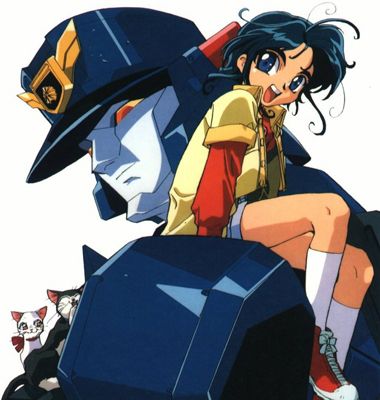 |
| He's a plucky grade school boy. He's a 20 foot tall transforming robot. Together, they fight crime! |
J-Decker is the fifth entry in the Brave metaverse. It takes place in the 21st century (remember, this was made in the 90s), where great leaps in technology has made the world a more dangerous place. Police now have to combat criminals with access to giant robots, as well as the threat of biomonsters and extraterrestrial threats. To combat these scourges, Japan’s police department created several sentient robots known as the Brave Police. Led by a young boy named Yuuta, the Brave Police fight all sorts of evil.
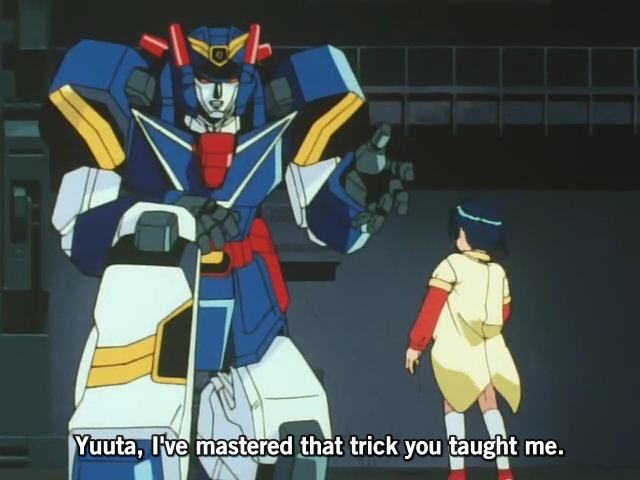 |
| But Deckard, tricks are for- *bricked* |
J-Decker’s story is simple without being an excuse to sell toys. Its episodic in nature, but it has enough story to carry over from episode to episode. And while it’s certainly targeted to younger kids,usually trying to teach morals like “stay true to yourself,” it often tries to address more complex themes, most importantly what it means to be human. While not terribly complex, and even a bit predictable, J-Decker’s story, as well as the the issues it tackles, is more than serviceable.
Characters
 |
| The Braves. From left to right: Dumpson, McCrane, Deckard, Power Joe, and Shadowmaru. |
This show basically has two sets of characters: the humans and the robots. There are a ton of characters, so instead of going through all of them, I’ll just go over the important one. Let’s begin.
 |
| J Decker, the union of Deckard and his J Roader. |
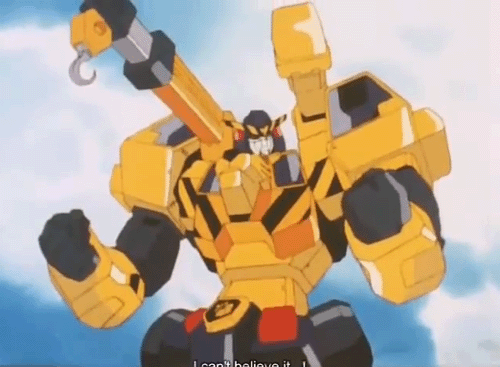
There’s Yuuta, the main protagonist who has befriended and leads the Brave Police, his sisters Kurumi and Azuki, Saejima, the head of the Japanese police, Azuma, the underhanded vice commissioner of the Japanese police, and Shunsuke, Saejima’s chief engineer. The robots include Deckard, Yuuta’s best friend who transforms into a police chaser, McCrane, a by-the-book mobile crane, Power Joe, a lighthearted power shovel, Dumpson, a straightlaced dump truck, and Shadowmaru, a ninja robot with multiple forms.
 |
| Build Tiger, the union of McCrane, Power Joe, and Dumpson. |
The robots are easily the best characters of the show, not only because they are the actual crime fighters, but because they have more interesting personalities. The human characters aren’t terrible, but outside the one’s mentioned above, they’re very one note and somewhat uninteresting. The cast of humans is still endearing, especially Yuuta’s family, but the show is stolen quite easily by the robots, especially when they interact with other humans.
Writing
 |
| ...said the robot holding a shotgun. |
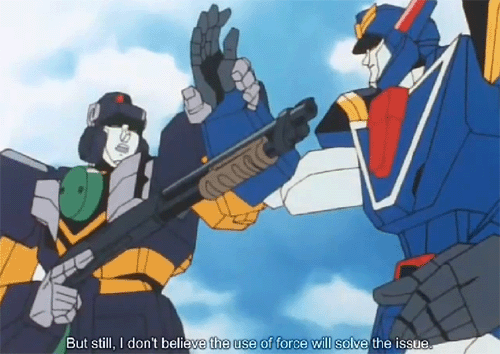
Usually in merchandise driven shows, the writing is extremely basic and written only for children. J Decker, while not written exceptionally, is written well enough to be enjoyable for older viewers. It supplies some surprisingly clever lines, and it handles its characterization and more complex issues quite well. The show also has a great sense of humor (for the most part), and it very rarely became grating. The only real complaint I have is that the writing's on the predictable side, but other than that, J Decker is a well written for a kids anime.
Animation
The animation of J Decker is actually pretty damn good. Sunrise really knows how to animate its shows, as the animation is colorful and involves several moments of fluid movement. The pieces of animation, without a doubt, are the gattai (or combination for my non-weeaboo readers) sequences. Yes, there are a few cases of recycled animation, but the show never abuses it. Overall this show has great animation, especially for a kid’s show.
Mecha and Fight Scenes
As said in my history bit, Takara reused some of its toy making assets when making the Braves, so it would make sense the robots of this anime heavily resemble Transformers. This isn’t a problem though, as I really like their designs. It has the right mix of simplicity and detail, sort of like the Transformers themselves. The combined robots have the same effect, being good looking without going overboard.
However, the weakest part of this show are the fight scenes. While the robots themselves are impressive, the fights don’t give them many chances to show their strengths. The fights with the villains of the week are often very short, and often don’t involve any neat treats or flashy attacks. The fights are unimpressive, and I can’t really think of any fight that actually caught my attention. For a super robot show, the fight scenes are very lackluster.
Conclusion
J Decker may be a kid’s show, but it’s a very good kid’s show. Even as an older viewer, I still enjoyed this show’s humor, animation, and storytelling. Its fights leave a lot to be desired, but overall, its worth watching.
7.5/10 - Really Good
Note: No new Mechanime for a while. Have a backlog to clear up. However, expect a game review or two to come out soon.
Subscribe to:
Posts (Atom)