Thursday, June 25, 2015

Press Start: Splatoon review

Paintball with squids! Or are they kids now?
Developers: Nintendo
Publishers: Nintendo
Genre: Third Person Shooter
Platforms: Wii U

Wow, another review about a game on my Top 10 Anticipated Games of 2015. When I made the list, Splatoon made number 7. However, as more details about the game leaked out, I grew more and more cautious. Sure, we got customizable loadouts, but we also got only 2 modes with five maps, with the rest being pushed back to be released later. Is there more to Splatoon than what the lack of modes suggest? Let’s find out.

Story and Concept
Inkopolis, the hub of the game. Here you can buy new gear, access multiplayer lobbies, and enter single player.
Splatoon takes place in a world inhabited by humanoid creatures known as Inklings, beings that can change into squids and can swim through ink. They are a race obsessed with fads and fashion, moving from one big thing to the next. In Splatoon’s single player, you play as a heroic Inkling working to foil an invasion of a vengeful race of Octolings. In the game’s multiplayer, you indulge in the latest fad in Inkopolis (home of the Inklings): Ink Battles. Also, there’s a cat named Judd. He’s cool.

Octo Valley, the single player mode.
As always, Nintendo’s creativity shines through in Splatoon. The world is very vibrant and creative, and has a surprising amount of depth if you collect the Sunken Scrolls in single player. However, the world of Splatoon does have one major drawback- it’s an open love letter to 90s culture. This wouldn’t be a problem, but here it feels forced and cheesy, feeling less like “remember the 90s?” and more like a parent's attempt to be cool. Its a creative world, but it’s also a cheesy one.

Graphics and Design
Graphics are not the most impressive thing in the world, but the colors easily make up for it.
The graphics of Splatoon are not the most impressive on the Wii U. Textures are simple, and character models are simple. However, this game makes up for that with its use of bright and vibrant colors. Not only is the game itself bright and colorful, but the colors of the ink used to cover territories sticks out in the best possible way. Splatoon may not be the best looking games on the Wii U, but perhaps it’s its most colorful.

Music and Sound

Splatoon is certainly unique when it comes to its sound design. The inhabitants of Inkopolis speak in gibberish that sounds like distorted, backwards Japanese. The music takes a similar direction, with vocals being garbled and distorted. The music itself covers all sorts of genres, but all sound like what Inkling teens would listen to. In a sense, you’re listening to Inkling pop. The sound design is very hit or miss, and while I personally love it, I can see why many others would not.

Gameplay
Single player is enjoyable, if not a brief experience.
While the main draw of Splatoon is its multiplayer, it does feature a pretty enjoyable single player. You play as an Inkling, stopping an army of Octolings as you use your weaponry and ability to swim through ink to progress through levels. The single player features some well designed levels (though they are prone to recycling challenges), and the boss fights can be fun, if not easy. The concept is short though, being 4 to 5 hours at best. It’s a fun ride, but in the end, you’ll breeze through it.

Gear gives your Inkling special abilities, allowing many ways to play.
The main attraction of Splatoon is its online multiplayer. Here, teams of four players battle each other in two modes: Turf War and Splat Zone. Turf War involves each team trying to cover as much of the map with their color ink in 3 minutes. Splat Zones have each team fighting over concentrated areas of the map. Playing matches nets you experience which is used to level up your Inkling. Leveling up allows you to unlock new weapons and clothing, the latter of which boosts your Inkling’s abilities.
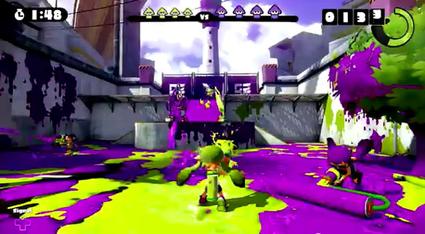
Every second counts in Splatoon, especially in Turf War.
Splatoon’s multiplayer is a very fun, if not very flawed, experience. Matches are chaotic and hectic, yet at the same time it rewards skill and forward thinking. The wide customization options given to you through gear certainly helps make matches more interesting. Matches can be addicting, but they can also be frustrating, especially when one team is composed of players of much higher levels with much better gear, which happens more often than you think. Still, it’s hard for me to just play a few matches and be done given the frantic fun the matches bring.

However, Splatoon suffers from a major lack of content. As I’ve said, the single player mode is 5 hours at best, and the lack of maps in multiplayer means you could play the same stage multiple times before switching. You’ll run out of things to do pretty early on, and it all comes down to how much you enjoy playing online. Granted, Nintendo has been adding new maps ever since release, but the lack of content is still a huge problem.

Conclusion
Splatoon is a very creative game, from concept to sound to visuals. Its fast and frantic multiplayer is often great fun, but without much else to do, those not a fan of Splatoon’s style of gameplay will find it has little to offer. Had Splatoon been heavier on content, it would have been one of the Wii U’s best, but it still stands as a great experience.

7.5/10 - Really Good

Friday, June 19, 2015

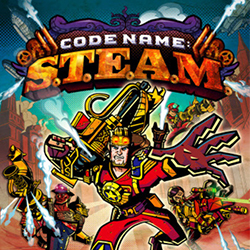
Press Start: Code Name STEAM review

Think you got enough steam there, Butch?

Developers: Intelligent Systems
Publishers: Nintendo
Genre: Strategy
Platforms: 3DS


Last year, I put together a list of the top ten games I was looking forward to in 2015. Code Name STEAM, a strategy game for the 3DS, topped the list. I mentioned that the developers, Intelligent Systems, had earned my respect, but recently I’ve been questioning that statement. Sticker Star was a mediocre outing for a Paper Mario game, and Awakening, while not terrible, isn’t on par with other Fire Emblems. For me, Code Name STEAM would either redeem Intelligent Systems or seal their fate as “meh” developers. Did their new strategy game do the trick? Let’s find out.


Story and Concept
Left to right: Tiger Lily (Peter Pan), Randolph Carter (Cthulhu metaverse), Henry (Red Badge of Courage), Tom (Tom Sawyer), and John (John Henry the Steel Driving Man).
Code Name STEAM takes place in an alternate version of the 1880s, in a world where steam power has allowed for many advancements. The Earth is threatened by a race of ice-based aliens who will stop at nothing to freeze the entire world. Earth’s only hope is STEAM, an organization headed by Abraham Lincoln (who in this universe had escaped assassination) that fights with steam powered weaponry. The team includes Henry Fleming, John Henry, Tiger Lily, Tom Sawyer, and 8 other characters from English literature.


Oh, and this is all actually a comic book being read by a kid after school.


Screw historical accuracy, I have a giant robot with a top hat!
This game, without a doubt, has the most out-there concept I’ve ever seen in a video game. Yet as soon as the concept was revealed, I fell in love with it. It’s very creative, and it's so outlandish and ridiculous it wraps around and becomes awesome. It’s like the world’s greatest B-movie in game form! It’s a shame the story of the actual game is pretty much just there to justify blowing up aliens as Wizard of Oz characters, but I suppose it fits with the whole comic book narrative.


Graphics and Design
The eagle is explosive. Because America.
Code Name STEAM has pretty good graphics for a 3DS game. The character models are fairly detailed and move fluently without too much trouble. The maps, while small, are pretty detailed as well. However, the graphics in this game really pull off the comic book art style with its use of color and cel-shading. One area it could have really improved on, however, are the cutscenes It tries to replicate comic panels, but that just results in the characters barely moving. Other than that, this is a fine looking game.


Sound and Music

This game features a fantastic voice cast, bringing in actors like Adam Baldwin, Wil Wheaton, Fred Tatasciore, Kari Wahlgren, and Paul Eiding. Each voice actor brings a lot of finesse to the table, and as a result, the voice acting in this game is great. The music is also amazing, with orchestral rock themes for the player’s turn and electronic music for the aliens. Each piece is crazy fun to listen too, and several stand out in the best of ways. On the sound front, Code Name STEAM dazzled me.


Gameplay
Stealth is a huge part of the game. Sneaking up on the enemies gives you a tactical edge.
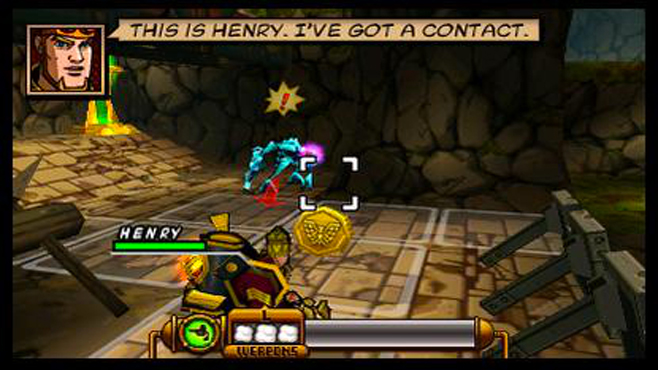
Code Name STEAM is a turn based strategy game with third person shooter elements, much like Valkyria Chronicles. You control a squad of four characters as they complete objectives. Character’s actions are governed by steam, which is needed to move, fire weapons, and perform actions. Characters with steam leftover during the enemy’s turn can still use some of their weapons to perform an Overwatch attack. If a enemy crosses a character’s line of sight, the character can perform an Overwatch and return fire. In addition, each character has a unique special attack they can use once per map.


Getting to the high ground is key to victory.
Code Name STEAM excels as a strategy title, mainly because it rewards good strategy. Advance too quickly through a map, and you’ll be crushed by superior numbers. Advance too slowly and you’ll be swamped with reinforcements. This may seem frustrating, but actually thinking about your moves will usually lead to rewarding victories. The maps themselves reflect this; they are usually compact and crawling with enemies, but advancing with a well thought out plan makes all the difference.


Each unit has a unique weapon. The Fox, for example, has a rifle with long range and low Overwatch cost.
Code Name STEAM is also a very well designed game. The game is challenging, as the enemy can use Overwatch too and is surprisingly clever sometimes, but the challenges rarely feel unfair. Each one of your weapons is well balanced (baring a few exceptions), and each squadmate has his or her uses. Most maps are designed so that the player is given a disadvantage at first but can be solved with good strategy. Code Name STEAM is expertly put together from a design standpoint.


Scarecrow is one of my favorite characters, but he's a bit too specialized to be considered a great unit.
Of course, this game is not without its faults. The game does not allow you to track enemies outside of the character’s line of sight, meaning when it's the enemies turn, you’ll have to wait as enemies you can’t see scuttle around the map (granted, the patch makes it so you can speed up the enemy’s turn, but it’s still a problem). The game does have a few poorly designed maps that are more frustrating than fair. And while all squadmates have their uses, some too specialized to be useful on most maps. Units like Henry and Lion are far more useful than Scarecrow or Queequeg because they can be used in more situations.


Verdict
Code Name STEAM is one of the best games I’ve played this year. Its creative, strategic, colorful, and challenging. I will admit it has some hit or miss qualities, but I had tons of fun with this game. It’s easily one of the best strategy games I’ve played.

8.5/10 - Terrific

Wednesday, June 17, 2015

Mechanime: Brave Police J Decker

HOLD UP!
Original Run: 1994-1995
Number of Episodes: 48
Average Episode Length: 21 minutes
Subgenres: Shounen
Dub?: No

Welcome back to Mechanime! Today we’ll be looking at an entry in the influential Brave series, J-Decker. Before we get to the review, I feel like I should address the history of the Brave series, as it’s important to understand the series as a whole.

A Brief History Lesson
The main Braves throughout history. J Decker is the fifth one.
The Brave series owes a lot to the Transformers franchise, and not only because they share a similar concept (robots that can take the form of vehicles fighting evil). Takara, the company that had the rights to the Transformers in Japan, had departed from Generation 1 in 1989. When the series began declining in popularity (resulting in the cancellation of the Transformers: Zone OVA series), Takara struck a deal with Sunrise, the studio behind the wildly popular Gundam series to create a new franchise alongside a new set of toys.

The Brave series is very similar to Transformers with one major exception: the draw was that the robots could combine. Usually, the main robot could combine with a large vehicle (usually a carrier of sorts) to form a more powerful robot. There were also usually two support teams of multiple robots that could also combine. Takara often reused assets such as toy molds leftover from their Transformers days when making toys, as well when designing their robots.

The first entry in the Brave series, Exkaiser, was far more popular than either Takara or Sunrise anticipated. Japanese audiences clamored for more, leading to 7 more entries in the Brave series, as well as a general revival of interest in the super robot genre. Even Transformers have references to the Brave series. Hope all of this helps in understanding the series when you think, “are you sure this isn’t Transformers?”.

Opening

All of the Brave animes have great openings, and J-Decker is no exception. The opening song, titled Heart to Heart, is a song filled to the brim with 90s cheese, and that’s exactly what makes it great. Not only is it overly dramatic, but it has this snack food like quality that makes it so you can’t stop listening to it. Heart to Heart is a great song, even if it has enough cheese to clog your arteries.

Story
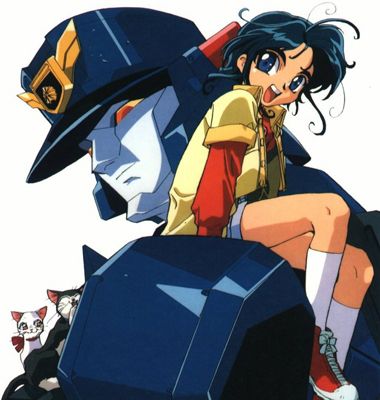
He's a plucky grade school boy. He's a 20 foot tall transforming robot. Together, they fight crime!
J-Decker is the fifth entry in the Brave metaverse. It takes place in the 21st century (remember, this was made in the 90s), where great leaps in technology has made the world a more dangerous place. Police now have to combat criminals with access to giant robots, as well as the threat of biomonsters and extraterrestrial threats. To combat these scourges, Japan’s police department created several sentient robots known as the Brave Police. Led by a young boy named Yuuta, the Brave Police fight all sorts of evil.


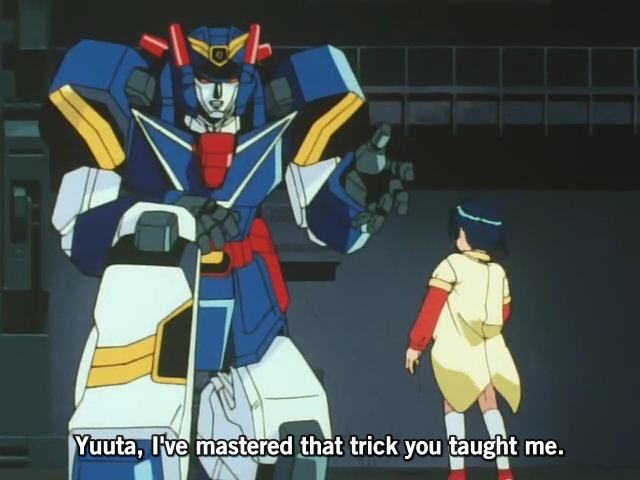
But Deckard, tricks are for- *bricked*
J-Decker’s story is simple without being an excuse to sell toys. Its episodic in nature, but it has enough story to carry over from episode to episode. And while it’s certainly targeted to younger kids,usually trying to teach morals like “stay true to yourself,” it often tries to address more complex themes, most importantly what it means to be human. While not terribly complex, and even a bit predictable, J-Decker’s story, as well as the the issues it tackles, is more than serviceable.

Characters
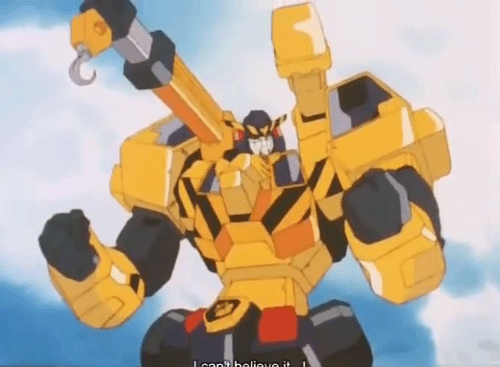
The Braves. From left to right: Dumpson, McCrane, Deckard, Power Joe, and Shadowmaru.
This show basically has two sets of characters: the humans and the robots. There are a ton of characters, so instead of going through all of them, I’ll just go over the important one. Let’s begin.


J Decker, the union of Deckard and his J Roader.
There’s Yuuta, the main protagonist who has befriended and leads the Brave Police, his sisters Kurumi and Azuki, Saejima, the head of the Japanese police, Azuma, the underhanded vice commissioner of the Japanese police, and Shunsuke, Saejima’s chief engineer. The robots include Deckard, Yuuta’s best friend who transforms into a police chaser, McCrane, a by-the-book mobile crane, Power Joe, a lighthearted power shovel, Dumpson, a straightlaced dump truck, and Shadowmaru, a ninja robot with multiple forms.

Build Tiger, the union of McCrane, Power Joe, and Dumpson.

The robots are easily the best characters of the show, not only because they are the actual crime fighters, but because they have more interesting personalities. The human characters aren’t terrible, but outside the one’s mentioned above, they’re very one note and somewhat uninteresting. The cast of humans is still endearing, especially Yuuta’s family, but the show is stolen quite easily by the robots, especially when they interact with other humans.

Writing
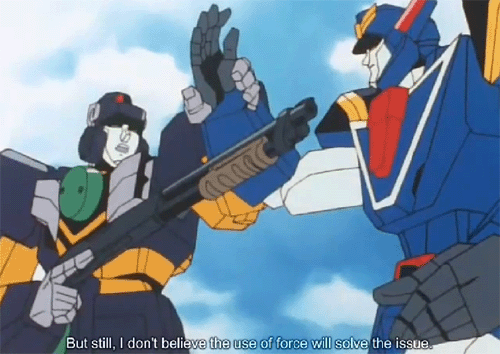
...said the robot holding a shotgun.
Usually in merchandise driven shows, the writing is extremely basic and written only for children. J Decker, while not written exceptionally, is written well enough to be enjoyable for older viewers. It supplies some surprisingly clever lines, and it handles its characterization and more complex issues quite well. The show also has a great sense of humor (for the most part), and it very rarely became grating. The only real complaint I have is that the writing's on the predictable side, but other than that, J Decker is a well written for a kids anime.

Animation

The animation of J Decker is actually pretty damn good. Sunrise really knows how to animate its shows, as the animation is colorful and involves several moments of fluid movement. The pieces of animation, without a doubt, are the gattai (or combination for my non-weeaboo readers) sequences. Yes, there are a few cases of recycled animation, but the show never abuses it. Overall this show has great animation, especially for a kid’s show.

Mecha and Fight Scenes
As said in my history bit, Takara reused some of its toy making assets when making the Braves, so it would make sense the robots of this anime heavily resemble Transformers. This isn’t a problem though, as I really like their designs. It has the right mix of simplicity and detail, sort of like the Transformers themselves. The combined robots have the same effect, being good looking without going overboard.

However, the weakest part of this show are the fight scenes. While the robots themselves are impressive, the fights don’t give them many chances to show their strengths. The fights with the villains of the week are often very short, and often don’t involve any neat treats or flashy attacks. The fights are unimpressive, and I can’t really think of any fight that actually caught my attention. For a super robot show, the fight scenes are very lackluster.

Conclusion
J Decker may be a kid’s show, but it’s a very good kid’s show. Even as an older viewer, I still enjoyed this show’s humor, animation, and storytelling. Its fights leave a lot to be desired, but overall, its worth watching.

7.5/10 - Really Good
Note: No new Mechanime for a while. Have a backlog to clear up. However, expect a game review or two to come out soon.

Sunday, June 14, 2015

Sentai Time! Movie Double Feature

Hello, all my lovely people! Today I’ll be reviewing two Super Sentai movies, both based on Sentais I’ve already reviewed. First up is…


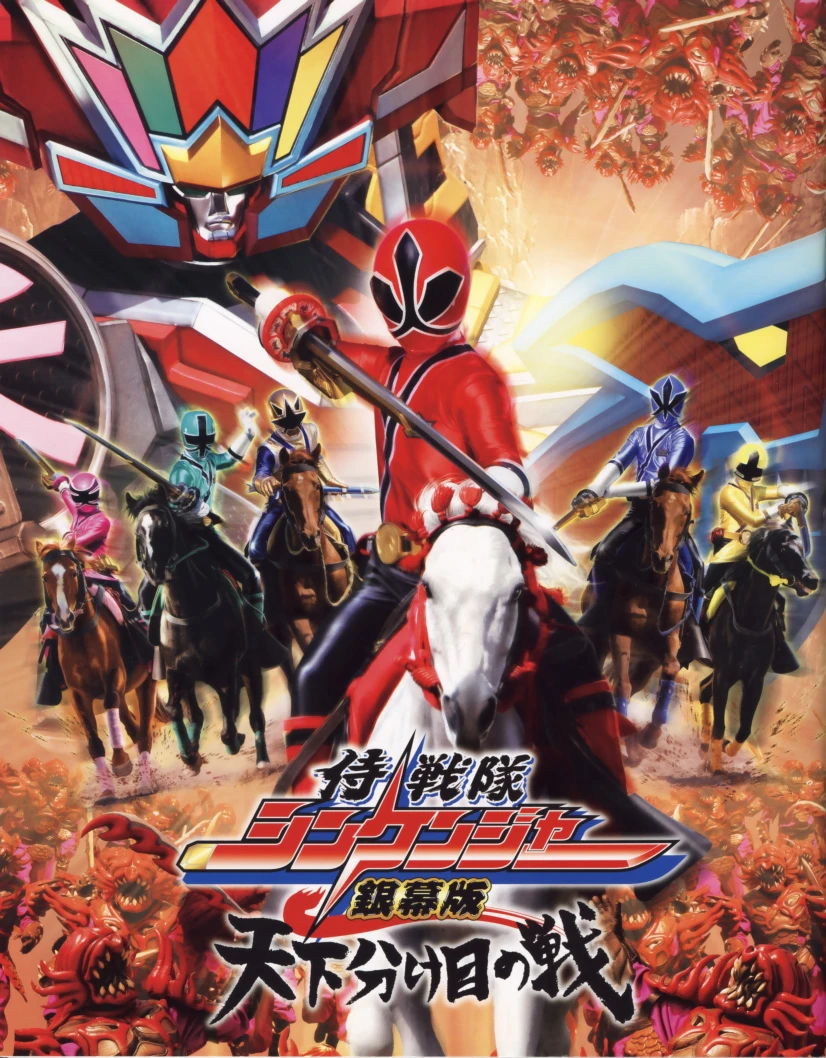
Shinkenger: The Fateful War
The closest thing we're going to get to a Super Sentai Musou game.

Fun Fact: This was the first Japanese movie to be filmed in 3D.


This movie was part of a double feature with the Kamen Rider film, “Kamen Rider Decade: All Riders vs Dai-Shocker.” This film takes place between episodes 24 and 25 of Shinkenger. The Shinkengers are engaged in a losing battle with the Kusare Gedoushu, a powerful faction of the Gedoushu that have resurfaced after 3 centuries. The Shinkengers’ only hope is a secret disk hidden away in a temple deep in enemy territory. When the disks yields little help, the Shinkengers choose to charge deep into enemy territory, hoping to win the war in one attack.


My biggest complaint about this film is its length. The whole thing is barely 21 minutes long, which makes its about the same length as a regular Shinkenger episode. I know it was part of a double feature, but I would have loved to see more of, well, anything. There’s one scene in particular that I thought could have been expanded: the duel between Juzo and Genta. We see the very beginning, but that’s about all we see. Even if the film was only five minutes longer, I would have prefered it.


That being said, while this does play out like an episode of Shinkenger, it's still a very good episode. All the great elements of the show are present, including the great characters, well choreographed fights, and a fair amount of drama. It also features two great additions that really make this stand out from anything in the show (at least from what I’ve seen). One would be the entire sequence where the Shinkengers engage a literal army of Gedoushu. Group fights have always been my favorite part of Super Sentai, and this film goes full on Musou with this concept, down to having the Shinkengers riding into battle on horses. Another addition would be the Kyoryumaru, a dinosaur sword. If that doesn’t sell you on how great it is, you have no taste.


The Fateful War may be on the short side, but it's still very good. Its a great addition to an already great show. I say it's worth a watch, even if it's just for to see the Shinkengers wreck a literal army. Next up is…


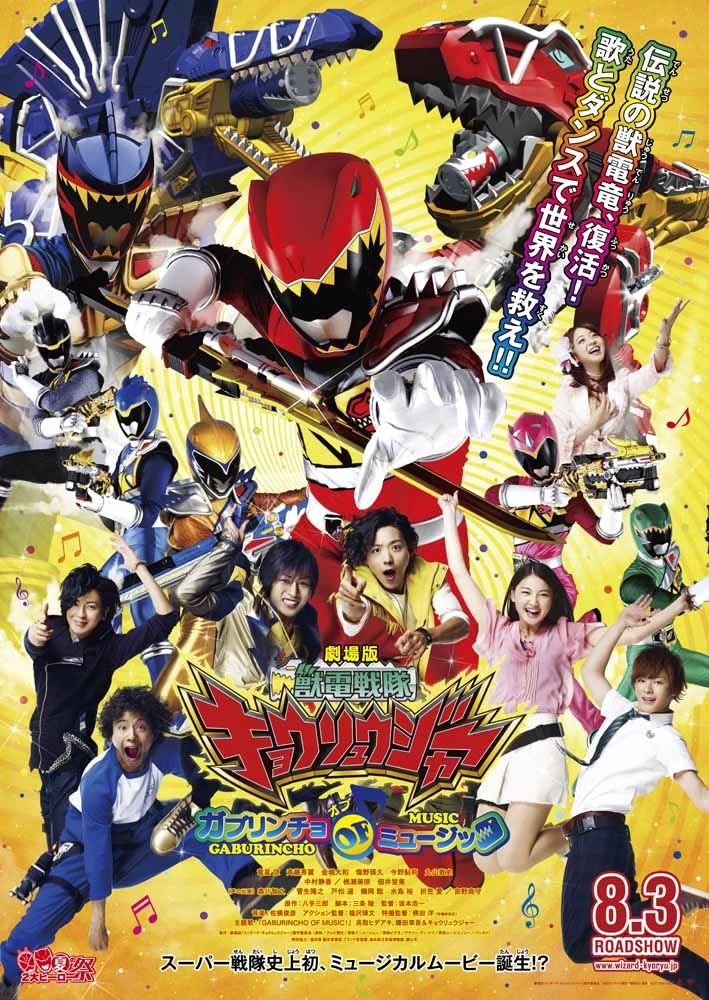
Kyoryuger: Gaburincho of Music
Some singing, all dancing.
This movie was part of a double feature with the Kamen Rider film, “Kamen Rider Wizard in Magic Land.” It takes place between episodes 20 and 21. The film details the Kyoryugers fight against D, a former member of the Deboss Army who has forced the lost ZyuDenRyu Tobaspino to be his partner. He kidnaps the popstar Mikito, an old friend of Daigo’s, and plans to use her power of song to wipe out humanity.


Gaburincho of Music bills itself as a musical, which I find to be a stretch. Not counting the insert themes, there are only three songs: one which is repeated throughout the movie, the ending dance number, and one with Candelira which basically amounts to a (admittedly hilarious) non-sequitur. the songs are fine songs, but calling your movie a musical when there isn’t that many musical numbers is kind of weird. I know this is a nitpick, but it does bother me.


One thing I have to both praise and criticize are the fight scenes in this movie. On the one hand, the fights are very visually impressive, with tons of crazy acrobatic flips and tons of flashy attacks that are a serious step above the show. On the other hand, the flash seems to be there to compensate for a lack of good fight choreography. Strip away the effects and the fights themselves are pretty average (aside from the acrobatics). They’re fun to watch, but they’re a bit too much flash and not enough fire.


Despite this, the film does have some great components. D is a great villain, being powerful, intimidating, and having a great design. Tobaspino is a very cool robot, and its humanoid form is kickass. Its a shame neither D’s Kyoryuger outfit or Tobaspino make an actual appearance in the show, since both are great additions. Despite this, however, I can’t really say that Gaburincho of Music is worth seeing unless you really like Kyoryuger.

Have a request, constructive criticism, or compliment? Leave a comment!

Friday, April 17, 2015

Mechanime: Gundam Wing

This anime passes just shy of flying colors. Get it? Wings? Flying?
...I'll be quiet now.
Original Run: 1995-1996
Number of Episodes: 49
Average Episode Length: 21-22 minutes
Subgenres: War
Dub?: Yes


What is up, my lovely people? Today I’ll be reviewing my first Gundam anime. As per usual, this is not a review of the entire anime, but just the first group of episodes. Let’s get started!


Opening

The opening of Gundam Wing, titled “Just Communication”, is probably one of the most average openings I’ve listened to. Its not the worse song, but it didn’t catch my interest at all. Quite frankly, I found the song to be boring and droning, which is something you don’t want your song to be. The worst part is that its probably the weakest part of an otherwise great soundtrack. Rather than being the show’s magnum opus or even the show’s hook, the opening is just there.


Story
Our heroes. Or as much as heroes child soldiers can be.
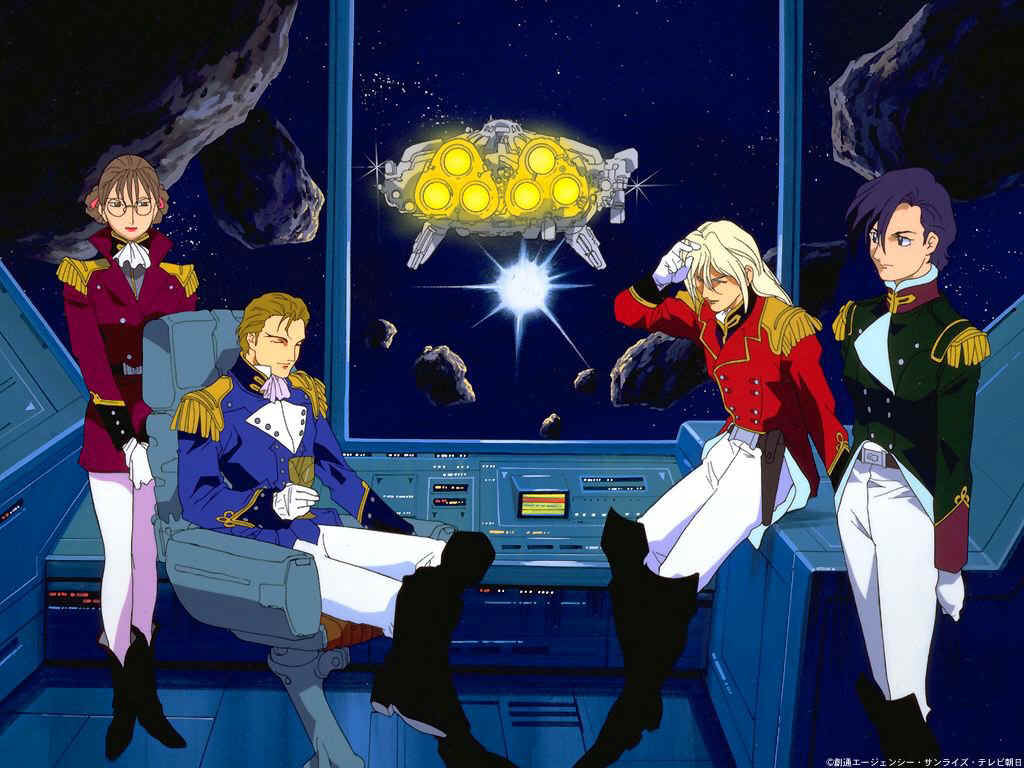
In the distant future, mankind has set up orbital colonies around Earth. However, the United Earth Sphere Alliance, an alliance set up to prevent armed conflict, begin seizing control of these colonies in the name of peace. The year is After Colony 195, and colonist rebels send five advance mobile suits (known as “Gundams” after the material they are named after) to Earth in hopes of winning their independence. Their target is the Organization of the Zodiac (referred to as OZ), a part of the Alliance military that have ambitious plans for the Earth and its colonies…


These people are the villains. Proving once again that evil is the more attractive side.
The story of this show is actually really good. It has several elements of political intrigue that kept me interested in the story. Its tale of a new order fighting the old guard, as well as the many battles fought in the name in peace is a great one, and is quite well told. Its a bit heavy handed with its antiwar message, and even though a lot is done in each episode, it feels like very little actually happens. While on the slow side, the story of Gundam Wing is probably the best reason to watch the show.


Characters
So we’re back to having ginormous casts again. Get a piece of paper ready. Ready?


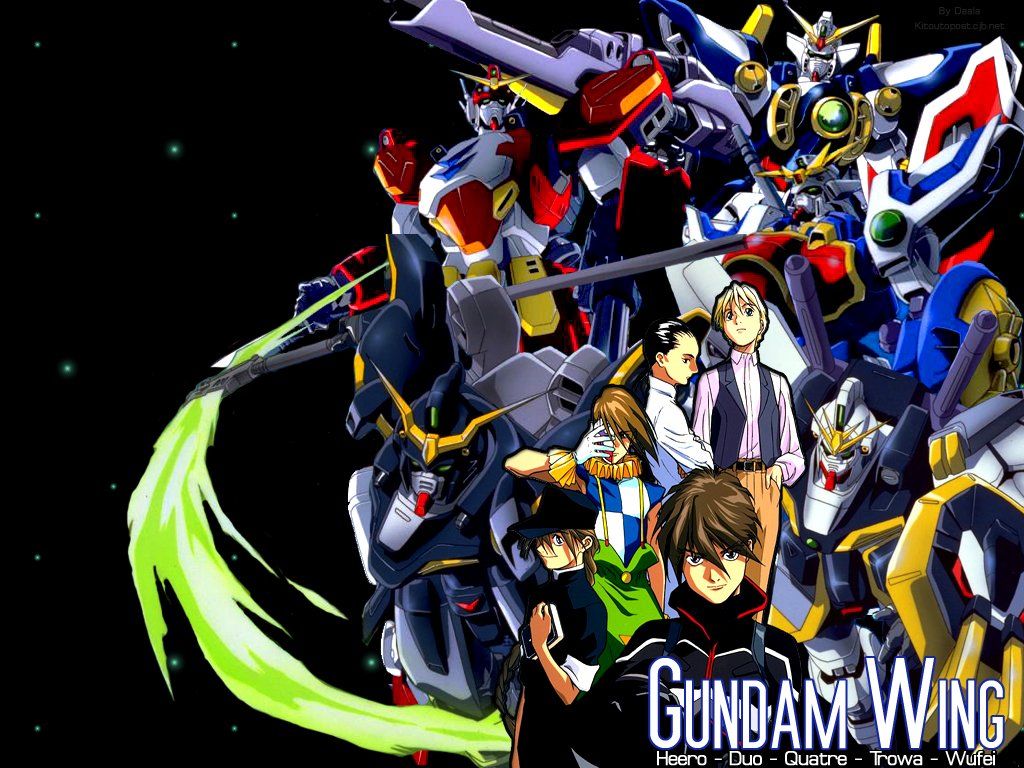
The Gundam pilots. From left to right: Quatre, Trowa, Heero, Duo, and Wufei.
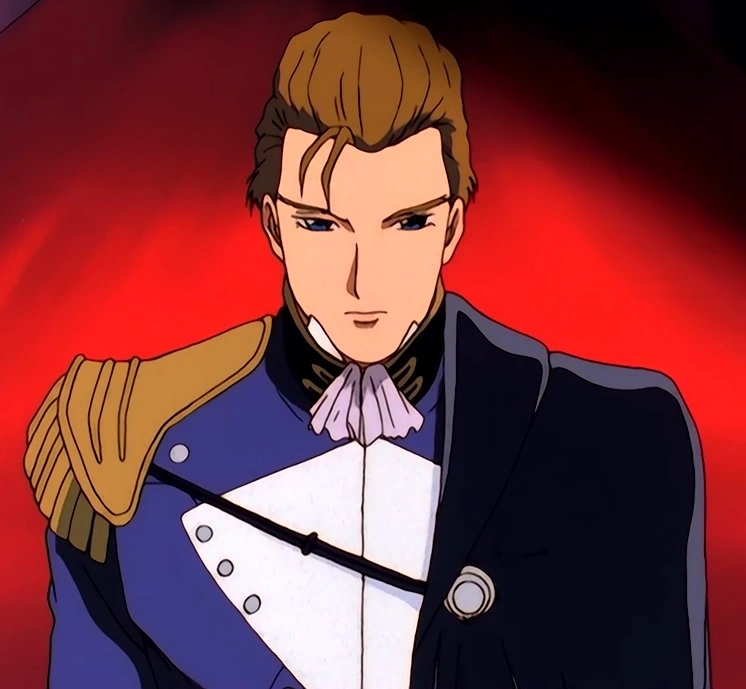
The rebels include Heero, a stoic killer trained since childhood, Duo, an upbeat  soldier, Trowa, a stoic and strategic marksman, Quatre, a rich and peace-loving boy, and Wufei, a young warrior. They use their Gundams to fight against OZ, led by Treize, a brilliant schemer. Serving him are Colonel Zechs, your obligatory masked character (seriously, every Gundam anime has one), Lieutenant Noin, a pilot trainer, and Lady Une, the right hand (wo)man to Treize. There’s also Relena, a girl that has a fascination with Heero.


Treize, the main villain of the series. His name means "thirteen," which is actually quite fitting.
The cast of Gundam Wing is pretty damn big, and unfortunately, a good deal with them are just plain uninteresting. Sure, Duo is pretty entertaining, and I really like Quatre, but Heero is far more boring than badass, Wufei is more insufferable than sympathetic, and Trowa is just there. Relena is completely pointless, and could easily be written out after the first few episodes. Fortunately the villains make up for it, and are easily more interesting than any of the rebels. Overall, I thought the cast was lackluster, and I couldn’t get into the characters as I did the story.


Writing
The writing of Gundam Wing is pretty mixed. For the most part, it tells its story well, and it at least tries to develop its characters. Its biggest weakness is how it tries to handle its anti-war message. While it does depict how war can have unintended consequences, it's also morally simplistic; the bad guys are clearly bad and the good guys are clearly good. While I have to give it some credit for tackling subjects live regional autonomy and freedom vs security, the way its written isn’t exactly stellar.


Animation
Not the most jaw dropping of fights, but I appreciate how the robots were animated.
For a 90s anime, this is very well animated. Sure, it recycles its animation occasionally, and its a bit explosion heavy, but its the right mix of colorful and drab, and the characters move enough to avoid looking choppy. I also have to give it major points for having its giant robots move like giant robots; the movements are slow and deliberate, and their mobility is actually pretty limited. Its not the greatest piece of animation, but its still a great looking anime.


Mecha and Fight Scenes
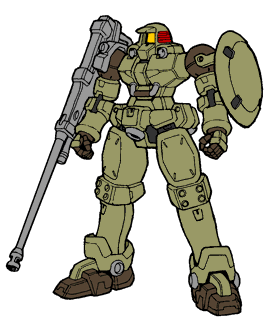
The grunt mobile suit for OZ, the Leo. The OZ suits look practical without looking boring.

The mecha of the Gundam series are referred to as “mobile suits,” but not all mobile suits are Gundams. In Gundam Wing, the Gundams are all made of a special alloy called gundanium, which can only be made in space-like conditions. In either case, the mech design in this anime is excellent. The non-Gundam mobile suits look pragmatic without looking boring, and the Gundams look very colorful and appealing without going overboard (well, for the most part).


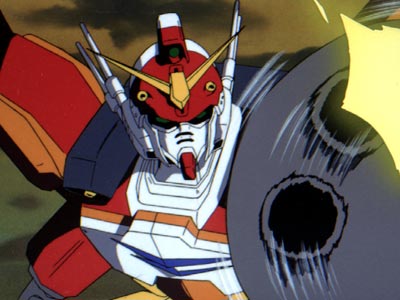
Gundam Heavyarms is best Gundam.
The fights are not so much “fights” as they are “battles.” Each battle is either between OZ and the forces that oppose them, or between the Gundams (often just one or two) and OZ. Either way, most suits don’t last long at all, as grunt suits are blown to smithereens by incoming fire (you know, like an actual mas produce weapon would). The Gundams easily plow through OZ suits, and its always fun to watch them do so. Even though I feel that these battles are great, they work to undermine the whole anti-war message. Still, the battles of this show are the other big reason to watch this anime.


Conclusion
Gundam Wing definitely has its shortcomings. Its characters are pretty weak, and its too heavy handed in its pro-pacifist/anti-war message. However, its balanced out by great villains, an intriguing story, and great battles. This is definitely worth a watch if you like giant robots.


7.5/10 - Really Good

Note: I know content has been coming out at a trickle, but school is taking priority right now. The good news is that I’m almost done with my “to-do” slate and ready for new shows! Best thing you can do is be patient (and maybe leave a comment, that always helps).

J-Decker is up next. Pull over!

Friday, April 10, 2015

Liberal Rant: Indiana's Religious Freedom Law


Back in 1993, the Religious Freedom Restoration Act was signed into law. The law says that the government cannot "substantially burden a person's exercise of religion." In other words, under the RFRA, if a person has sincere religious objections to a law, then he or she can challenge it in court. Today, 21 states have passed similar laws. With all this in mind, it seems hard to object to what Indiana is doing, at least from a legal standpoint. Some have even gone as to say that Indiana’s law is basically the same as the OB (“original bill,” for those not hip to today’s legal lingo), and that objections are ill-founded.


But if that were the case, then there wouldn’t be this huge backlash. Indiana’s RFRA is quite different. The most notable difference between the two is that every other RFRA only covers disputes between an individual or group and the government, whereas the Indiana law extends this right to object to disputes between private citizens. And by citizens, I don’t just mean actual people; the law can extend to any organization, partnership, LLC, corporation, company, firm, church, religious society, and what have you. This broadens the scope of the law immensely, and ultimately means that any individual or group can deny service to certain people on religious grounds.


The Indiana law is a solution in search of a problem. Even if we take possible discrimination out the equation, its still a law that addresses an issue that’s practically non-existent. The citizens of Indiana never really had their religious rights attacked. I could understand the need for such a law if there were precedent, but at the moment, this law seems to create more problems than it solves. It allows businesses to deny services to certain customers (not just gays, but also potentially Jews, Muslims, and even Christians), and it allows those businesses to hide behind religious freedom as justification.


I don’t hate religious freedom. I think the ability to practice your religion of choice without government interference is an important civil right. But using religion as an excuse to not treat all people equally is not exercising religious freedom; that’s discrimination. While I’m all for protecting religious rights, I also think its important to protect general civil rights. And its not like you can’t do both; the original RFRA does so. As it stands, the Indiana law aims to protect religious rights by allowing others to violate the civil rights of people they don’t like. Essentially, we have a law that prioritizes religious rights over some people’s civil rights, which is not something you should be proud over.

I’m so glad the Indiana law got this much backlash. A law like this has no place in modern America. Hopefully the bill will be replaced with something more sensible.

Thursday, April 2, 2015

Some bad news...

Guys, I have a bit of bad news for you guys. Up until now, I was able to easily balance this blog and work at school. Now, school is stepping it up a bit. So until I can clear up my backlog of work, this blog will be on hiatus. Sorry.

But don't fret; I have plenty of material for when I come back!

-Sentai Time! Movie review double feature
-Mechanime: Gundam Wing
-Liberal Rant: Religious freedom laws
-Sentai Time! Kyoryuger follow-up

Hope you guys understand. Until then, see ya.